What Is S&OP? A Practical Guide for People Who Actually Have to Run It

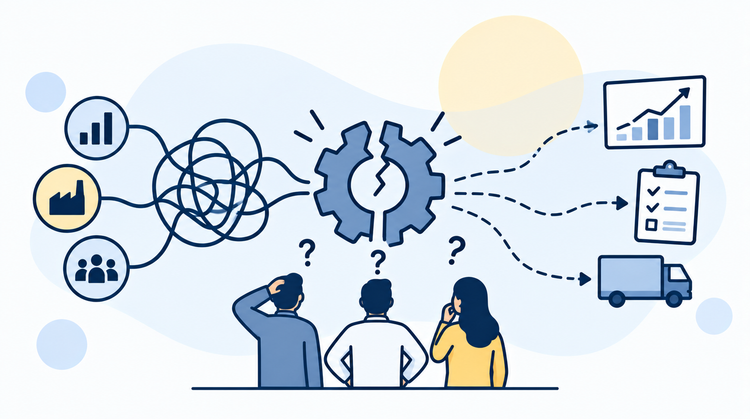
Most explanations of S&OP start with a diagram. A neat monthly cycle, five boxes, arrows flowing cleanly from Demand Review to Executive S&OP.
That diagram has never once matched what actually happens in a business.
Real S&OP is messier. It's a sales team that submitted a forecast they don't believe in. It's a supply team that's already decided what they can make regardless of what demand says. It's an executive meeting that spends forty minutes on a slide nobody needed and five minutes on the one decision that actually mattered.
So let's skip the diagram and talk about what S&OP is actually for.
S&OP is a decision-making process, not a meeting
Sales and Operations Planning exists to answer one question, repeatedly, on a set rhythm: given what we now know, what should we do differently?
Not "what happened last month." Not "whose forecast was more accurate." Those are useful inputs, but they're not the point. The point is a forward-looking decision: do we need more capacity in ten weeks, should we chase this demand upside or let it go, is there a supply risk we need to act on now while there's still time to do something about it.
If your S&OP process isn't producing decisions like that, it isn't really S&OP. It's a reporting meeting wearing an S&OP name badge.
Why it exists
Every part of a business optimises for something different by default.
Sales wants to sell more. Supply wants stability and low cost. Finance wants predictability. Operations wants a schedule that doesn't change every five minutes. None of these goals are wrong, but left alone, they pull in different directions, and usually nobody notices until inventory is either stacked to the ceiling or completely empty.
S&OP is the mechanism that forces those groups to reconcile their view of the future before it becomes an operational problem. It's not there to make everyone agree. It's there to make sure disagreements get surfaced and resolved at a point where the business can still do something about them.
The planning horizon matters more than people think
A lot of S&OP processes fail for a boring reason: they're looking at the wrong time horizon.
If your S&OP meeting is mostly discussing next week, that's not S&OP... that's expediting, and it belongs in a different meeting entirely. By the time you're a week out, most of your levers are gone. Capacity is what it is. Inventory is what it is. You're just managing consequences now, not making decisions.
S&OP earns its value further out, typically 3 to 18 months, depending on your industry's lead times. That's the window where you can still add a shift, place a purchase order, adjust a price, or change a promotional plan. Pull the horizon in too close and you've turned a decision-making forum into a status update.
What a working S&OP process actually contains
Strip away the corporate language and a functioning process usually has four ingredients:
A forecast someone owns. Not a number that gets adjusted by everyone in the room until it's meaningless, a forecast with a single accountable owner, built from a clear method, that other functions can challenge but not silently override.
A supply view that's honest about constraints. If supply can't actually make the volume being discussed, that needs to be on the table early, not discovered in week three of a nine-week lead time.
A gap, clearly stated. Where demand and supply don't match, someone needs to say so in plain terms, not bury it in a spreadsheet nobody opens.
A decision, with an owner and a date. This is the part most processes skip. Meetings end with "we'll keep an eye on it" instead of "we're building an extra week of stock, starting Monday, owned by production."
Why most S&OP meetings don't produce decisions
Usually it's not that the process is badly designed on paper. It's one of a few specific failures:
- The meeting is too big, so nobody wants to make a call in front of everyone
- The data arrives so late that there's no time left to actually discuss it
- Nobody owns the follow-through, so decisions from last month quietly evaporate
- The forecast is treated as a commitment rather than a planning assumption, so people are afraid to change it even when it's clearly wrong
Any one of these is enough to turn a good process into forty-five minutes people resent being in.
A simple way to know if your S&OP process is working
Ask this after your next meeting: what did we decide, and who is doing something differently as a result?
If the honest answer is "we reviewed some slides," the process isn't working yet, regardless of how well-designed the calendar or the templates are. Good S&OP is judged by the decisions it produces, not the meetings it holds.
Next in this series: S&OP vs IBP: what's actually different? — and if you want to see how this plays out with real numbers, the Nerd Foods dataset includes S&OP scenario data (base/upside/downside) you can practise against.
Member discussion