What Is Demand Planning? A Practical Guide

Ask ten people what demand planning is and most will say "forecasting." That's not wrong, but it's incomplete in a way that causes real problems.
Forecasting is one input into demand planning. Demand planning is the broader discipline of deciding what the business believes it will sell, and building enough confidence in that number that supply, finance and production are willing to act on it.
That distinction matters more than it sounds like it should.
A forecast is a statistical estimate. A demand plan is a decision.
A forecasting model can tell you, based on history, seasonality and trend, that you'll probably sell 12,000 units next month. That's useful, but it's incomplete on its own. It doesn't know about the promotion sales just agreed with a customer. It doesn't know a competitor went out of stock last week. It doesn't know you're launching a reformulated version in six weeks that will cannibalise the old one.
Demand planning is the process of taking that statistical baseline and layering in everything the model can't see, then landing on a single number the business can plan against. It's part statistics, part judgement, part negotiation.
Skip the judgement and negotiation part, and you get a technically accurate forecast that's practically useless, because nobody upstream believes it enough to act on it.
What a demand planner actually does, day to day
Less time is spent building models than you'd think. Most of the job is:
Reviewing the statistical baseline. Checking what the forecasting engine spat out, sense-checking it against what's actually happening in the market, and deciding where it needs a human override.
Gathering demand intelligence. Talking to sales about upcoming promotions, new listings, competitor activity, or customers ramping up or down. This is the unglamorous part that actually determines forecast quality.
Reconciling different views of the future. Sales often has a different number than the statistical model. Finance has a budget number that was set months ago and hasn't been updated. Someone has to decide which number the business is actually going to plan against, and it's rarely as simple as picking the most optimistic one.
Measuring how wrong you were, and why. Forecast accuracy tracking isn't about punishing bad forecasts. It's about learning which products, customers or time horizons are consistently hard to predict, so you can either improve the method or hold more safety stock to cover the uncertainty.
Communicating the number, and its confidence. A demand plan without a sense of how confident you are in it is dangerous. "We think it's 12,000, but this SKU has been volatile the last three months" is a completely different planning input than "we think it's 12,000 and we're quite sure."
Run rate vs forecast: which should you use?
This comes up constantly, and the honest answer is: it depends on what's changed.
If nothing meaningful has changed, no promotions, no new distribution, no market shift, recent run rate is often a better predictor than a forecast that hasn't been touched in weeks. Simple, recent, unadjusted history frequently beats a stale "official" number.
But run rate has a blind spot: it assumes the future looks like the recent past. It won't see a promotion coming. It won't see a listing loss. It won't see a competitor stockout sending demand your way. Anything that's about to change the trajectory needs a forecast that actively incorporates that knowledge, run rate alone will always be a lagging indicator.
The practical rule: use run rate as your sense-check, and be suspicious of any forecast that's drifted far from it without a clear reason why.
Why your sales forecast is probably wrong
Not because sales teams are bad at their jobs. Because the incentives are misaligned.
A sales forecast is often really two different things wearing the same name: a target (what we're aiming to sell) and a prediction (what we actually expect to sell). Those get confused constantly, and when they do, the number in the system tends to drift toward the target, because nobody wants to submit a number that looks like they're not trying hard enough.
The fix isn't blaming sales. It's separating the two conversations explicitly: what's the ambition, and separately, what do we honestly expect to happen. Good demand planning processes ask for both and don't punish an honest "we probably won't hit the target this month."
The real point of demand planning
It's not to be right. Nobody's forecast is ever exactly right, and chasing perfect accuracy is a waste of energy that would be better spent elsewhere.
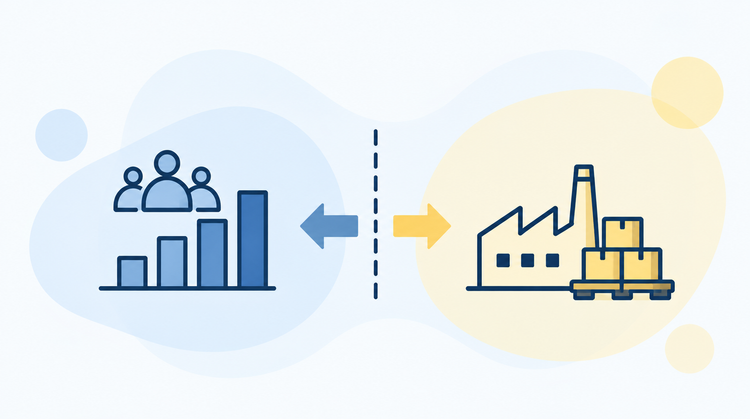
The real point is to give the rest of the business a number worth planning against, one that's as good as it reasonably can be, with an honest sense of how much to trust it, updated often enough to stay useful. Supply planning, inventory targets and production schedules are all downstream of this. Get the demand plan meaningfully wrong, and everything built on top of it inherits that error.
That's why demand planning sits at the front of the S&OP process, not because it's the most important function, but because everything else is reacting to what it produces.
Next in this series: What is supply planning? — and if you want to practise building a demand plan on realistic data, the Nerd Foods dataset includes 104 weeks of demand history across six customers.

Member discussion