7 Signs Your Planning Process Is Costing You Margin
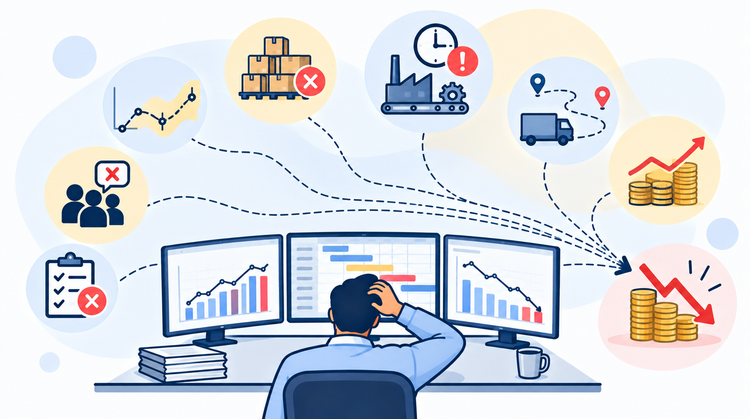
Weak planning rarely shows up as a line on the P&L. It hides in freight, overtime, write-offs and short deliveries. Here are seven signs to look for, and how to check each one.
How to Build a Seasonal Forecast in Excel, Step by Step
A moving average will always be late to a seasonal peak. A seasonal index fixes that with one extra column and an AVERAGEIFS. Here is the method, tested on two years of data.
Why You're Out of Stock and Overstocked at the Same Time
A full warehouse and short orders in the same week is not bad luck. It is a mix problem, and you can confirm it in an afternoon with a spreadsheet.
Why Most S&OP Processes Don't Work
Plenty of businesses have an S&OP process on paper. A calendar, a set of meetings, a template deck. Far fewer have one that actually changes what the business does. Here's what usually goes wrong, based on the patterns that show up again and again.
How to Build a 13-Week Supply Plan
Thirteen weeks is a common horizon in supply planning for a good reason: it's usually long enough to cover most lead times end to end, short enough to stay genuinely actionable, and it maps neatly onto a quarter, which makes it easy to talk about with the rest of the business.
Production Planning vs Production Scheduling
These two get used as if they're the same thing, and in a small operation they might genuinely be handled by the same person on the same day. But they're different jobs, working at different time horizons, and confusing them is a common source of friction between planning and the factory floor.
How to Measure Forecast Accuracy: MAPE, WAPE and Bias Explained
You can't improve a forecast you're not measuring properly. And a surprising amount of forecast accuracy measurement in the real world is quietly broken.
Weeks of Cover: The Simplest Inventory Metric You're Probably Using Wrong
Weeks of cover is one of the first metrics anyone learns in inventory planning, and one of the most commonly misused. The calculation is simple. The judgement around it is where most people go wrong.
Safety Stock Explained Without the Textbook Nonsense
Safety stock exists because you're wrong. Your customer won't buy exactly what you forecast. Your supplier won't always deliver exactly when they promised. Production won't always make exactly what was scheduled. Safety stock is inventory you deliberately hold to absorb some of that uncertainty.